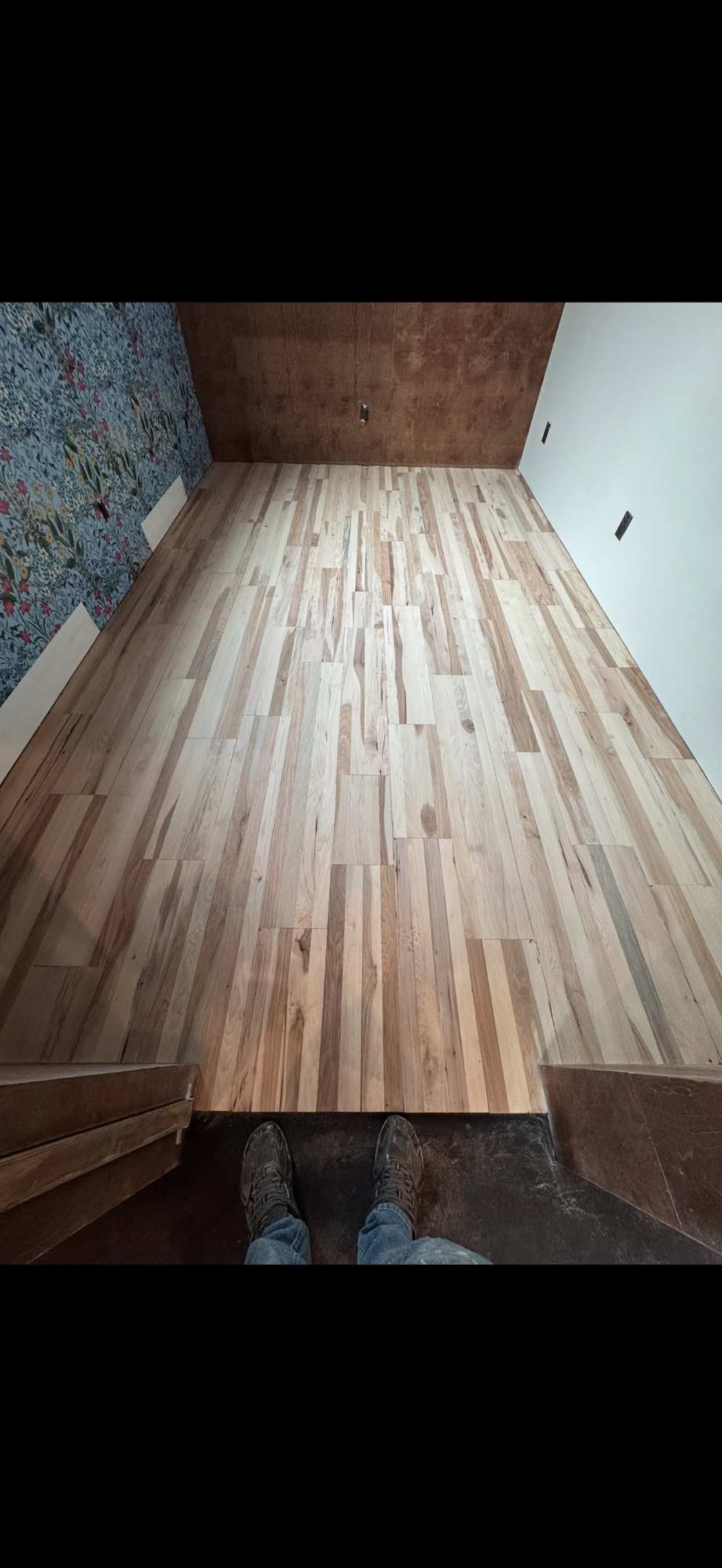
Refinishing a floor is disruptive for a few days, and most of the stress comes from not knowing what to expect. Here's the whole sequence, honestly, so you can plan around it.
It starts with the room being emptied and sealed. Furniture comes out, and we seal doorways, vents, and any opening into the rest of the house with plastic. That containment is what keeps sanding dust from migrating into rooms we're not working in, and it matters more than most people realize.
Then the sanding, which is usually a full day and comes in passes. The first coarse pass takes off the old finish and levels the boards. Successive finer passes remove the scratch pattern the previous grit left behind — this is the part cheap jobs rush, and it shows up permanently once stain goes on, because stain settles into every scratch left in the wood and makes it darker. Edges and corners get worked separately with an edger and by hand, since a big drum sander physically cannot reach a baseboard.
On dust: our equipment is dust-contained, capturing the great majority of it at the source. It is not dust-free, and anyone who tells you their sanding is completely dust-free is overselling. What's realistic is that the work area stays manageable and the rest of your home stays clean. We'd rather set that expectation honestly up front.
Stain comes next, if you're changing color. Before we commit, we put sample patches directly on your sanded floor — not on a scrap board, and not from a brochure. Species, age, and grain all shift how a stain reads, and red oak takes color very differently from white oak or maple. Seeing it on your own wood, in your own light, is the only reliable way to choose.
Then the protective coats, and this is where patience pays. Water-based polyurethane dries fast, stays clear, and has much lower odor, so you can often get multiple coats down in a day. Oil-based takes longer between coats and has a strong smell, but it ambers slightly over time in a way many people like on traditional oak, and it's very durable. Either way we buff between coats so they bond properly.
Curing is the part people get wrong. Dry and cured are different. You can typically walk on a finished floor in socks after about 24 hours, but the coating keeps hardening for days. Furniture generally goes back after 3 to 5 days, and area rugs should stay off for two to four weeks — putting a rug down early traps solvent and leaves a permanent outline. We'll give you exact numbers for the finish used on your job.
A few things that help: plan to be out or in another part of the house during sanding and coating, arrange for pets to be elsewhere, and don't schedule refinishing the same week as a party. Call (973) 960-5635 and we'll lay out a realistic schedule for your rooms.